
Claiming Territories, Ebenezer Christian
By liberating the lion from the confines of the cage and allowing it to project beyond the wall, Ebenezer Christian transforms sculpture from an object of observation into an encounter, where materiality, perception, and spatial authority converge.

German philosopher and cultural critic Walter Benjamin defined "aura" as the uniqueness of something captured at a particular moment and in a particular place, a never-to-be-repeated quality that resonates in the uniqueness of the medium itself, resulting from a personalized touch. Relating this aura back to art's earliest origins in religious ritual, Benjamin pointed to the necessity that the cult object be an original in order to produce its effect, for which substitutes or copies would be powerless. Secularization did little to diminish the importance of the aura-filled aesthetic original, and from the Renaissance through Romanticism an ever-increasing premium was placed not only upon the originality of an artist's conception but also upon the sense that the line or brushstroke delivering that idea was inimitable. Ebenezer Christian's sculpture, Claiming Territories, could be considered a compelling example of this desire, in which, as though by magic, Christian captures the most intuitive gesture of a roaring lion before the viewer, suggesting an imminent attack through a cold-cast sculpture carved with iron fillers, resin, and fiberglass.
Conceived following a visit to the zoo with friends, Claiming Territories arrests a specific movement and an aggressive expression, exhibiting the institutional authority that Panthera leo holds over the physical, irrespective of its context—even within a cage. In this sense, Claiming Territories owes much to the craft of Auguste Rodin. The sculpture's powerful impression derives in large part from the Western sculptural tradition since antiquity—a tradition that demanded the sculptor "give life" to marble (the myth of Pygmalion), creating the illusion, or rather the pretense, that the statue possesses organic life, a stylistic feature central to Rodin's public art. Christian develops this idea of infusing life by freeing the apex predator from the cage so that it appears to protrude outward from the very wall upon which it is installed.


Claiming Territories [Close up] by Ebenezer Christian

Claiming Territories [Side view] by Ebenezer Christian
The aesthetic honesty of this cold-casting process operates on two levels. First, it responds to the specific nature of the materials from which the sculpture is made—iron, resin, and fiberglass. Iron, a heavy and dense metal, is one of the few elements capable of retaining a magnetic field while conducting both heat and electricity. Resin is a highly durable and versatile material known for its exceptional adhesion and tensile strength. Fiberglass, by contrast, is considerably lighter than metal while remaining capable of supporting substantial loads. The affinity between the "lexical" properties of these three materials and the defining characteristics of the predator forms an integral aspect of Christian's cast. Second, the immediacy of this response resists the replication of this specific integral expression of the subject, thereby ruling out the production of the multiple. Christian further encodes the sculpture in monochromatic black, situating it within the "urban concrete jungle," where the object's visibility is largely determined by its reflection of artificial light. This black tonality meticulously captures the stealth of a lion stalking its prey—the viewer.
Christian's sculpture is realistic and strictly frontal. The dematerializing effect of light upon its surfaces, whereby the contours of the predator's facial landmarks are defined through shadow and can only be fully experienced from a single vantage point, constitutes a defining characteristic of the work. Christian demonstrates a profound understanding of Rodin's principle of materiality, maintaining both the integrity and the physicality of the sculpture. Indeed, he appears to unify this understanding with the Wagnerian aspiration toward the condition of the Gesamtkunstwerk, in which all the senses and perceptual elements converge into an intensified experience encompassing the visual, cognitive, and somatic—that is, physical—interactions with objects, structures, and materials. Christian methodically captures the dynamic shifts in a lion's facial expression during a roar. The trumpet-like "O" shape of the mouth, the dramatically lowered jaw, the forward position of the lips, the concealment of the teeth, the squinted eyes, the pronounced muscular tension, and the prominent wrinkles together register the maximized acoustic resonance of the roar, situating the viewer to experience the sculpture through all perceptual dimensions: visual, cognitive, and somatic. In doing so, he constructs a manifestly rational, archival, and institutional equation between the sculpture and its viewer: apex predator and primate.
![Ebenezer Christian, Claiming Territories [work in progress]](https://static.wixstatic.com/media/fe7a5e_3c17cb3931b44385ba0af33bc87ca8c9~mv2.jpg/v1/fill/w_909,h_606,al_c,q_85,usm_0.66_1.00_0.01,enc_avif,quality_auto/IMG_Ebenezer_Christian_ClaimingTerritories_WIP.jpg)
Claiming Territories [material view and work in progress] by Ebenezer Christian
It is helpful to consider the proposition advanced by the German-American art historian Rudolf Wittkower, together with the example of Rodin, namely the theories of the German sculptor Adolf von Hildebrand (1847–1921). Hildebrand maintained that all sculpture should function as a disguised relief composed of three planes staggered in depth, whose legibility should be immediately accessible from a fixed point of view. An actual relief, Hildebrand argued, was even more effective because the framed figures were thereby virtually freed from confronting the anxieties of infinite surrounding space. In Claiming Territories, Christian deliberately disobeys Hildebrand's proposition. The relief's background functions like the picture plane formulated during the Renaissance by Leon Battista Alberti: a virtual plane assumed to be transparent. In several respects, Claiming Territories may therefore be understood as an antithetical response to Hildebrand, as the figure suddenly projects beyond its supporting background—in this instance, the wall upon which it is installed. Nevertheless, Christian ultimately remains within the core traits that defines the figure that define the figure. By liberating the predator from the shackles of the frame—the cage of the zoo—he transforms the "infinite surrounding space" into the very territory to be claimed by the lion.
_35_X40_X18_JPG.jpg)
Ebenezer Christian,Claiming Territories. Iron fillings, Resin, fibreglass - 35 x 40 x 18 inches
Who is Ebenezer Christian?
Ebenezer Christian (b. 1992, Cape Coast, Ghana) is a multidisciplinary artist based in England whose practice is centred on sculpture and material experimentation through iron filings, resin, fibreglass, and found objects. He holds a Bachelor of Fine Arts in Sculpture (2018) and an MPhil in Art Education (Sculpture) (2021), academic foundations that inform a practice balancing technical innovation with critical conceptual inquiry. His research-driven approach integrates modelling, casting, carving, welding, drawing, and painting to investigate the expressive and symbolic potential of sculptural assemblage.
Christian's work explores the interconnected themes of environment, labour, precaution, ambiguity, cultural memory, and defence mechanisms through the language of cold-cast relief sculpture. Best known for embedding magnets within sculptural forms and applying iron filings that evolve through magnetic interaction, he creates works that evoke speculative archaeological artefacts in which mechanical and organic identities converge. Characterised by material transformation, layered textures, and an engagement with temporal uncertainty, his practice examines how matter embodies history, tension, and resilience. Significant bodies of work, including The Tribute Series, Ambiguity of Mask, and Taming Fear, exemplify his sustained investigation into memory, perception, and the mutable relationship between humanity and its environment
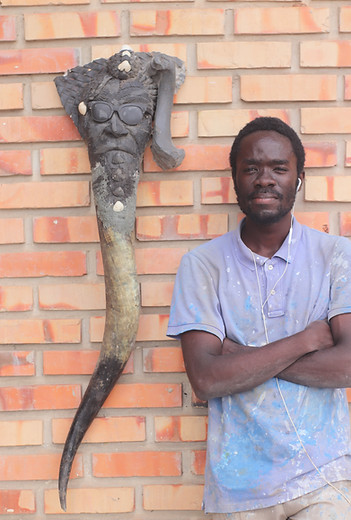
Ebenezer Christian, Sculptor
Ebenezer Christian has presented his work in exhibitions including We Know Within (Tab Art Ghana, Kumasi, 2019), Just DoIt (Tab Art Ghana, Kumasi, 2021), The Galamsey Culture (solo exhibition, Street View, KNUST, Kumasi, 2022), Parndon Mill Art Salon (Harlow, England, 2024), and States of Being (Domio Gallery, São Paulo, Brazil, 2026). His works are held in notable collections including the KNUST Office of the Vice Chancellor, Kumasi, Ghana (Pan Africanist, 2020; Vision, 2020), and a private collection in Hawaii, USA (Aloha, 2021), reflecting the growing international recognition of his materially innovative and conceptually rigorous sculptural practice.
- Siddhant Khattri, Partner at Vedica Art Studios and Gallery


Contact Gallery
General:
Sale inquiry:
Siddhant Khattri, Partner
Pete Malmberg, Director
website: https://www.vedicaartgallery.com