
ARIE OTTEN
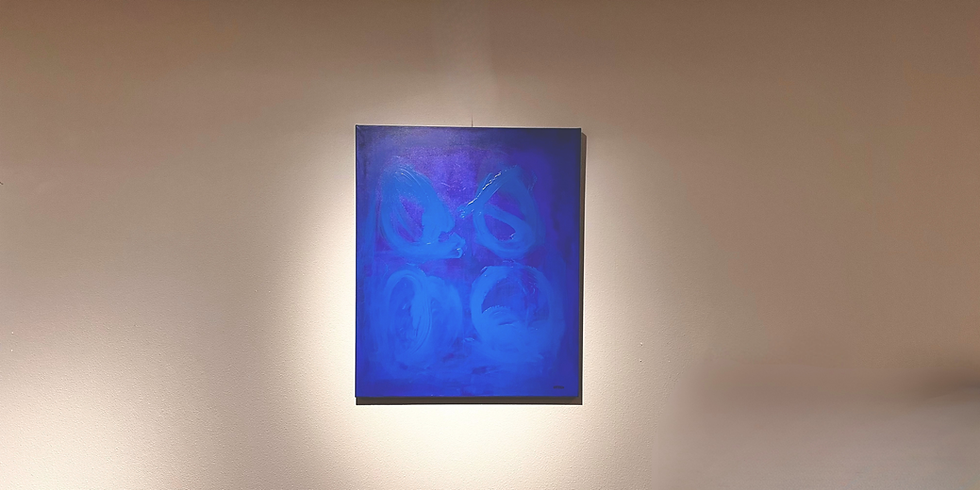
There are artists who work from imagination. Others work from observation. And then there are those rare individuals whose work emerges from the fragile border between life and non-life—between what the body can endure and what the spirit refuses to abandon. Arie Otten belongs firmly to this latter lineage: an artist who paints, quite literally, in the hours when the body loosens its grip on suffering long enough to let the hand move.

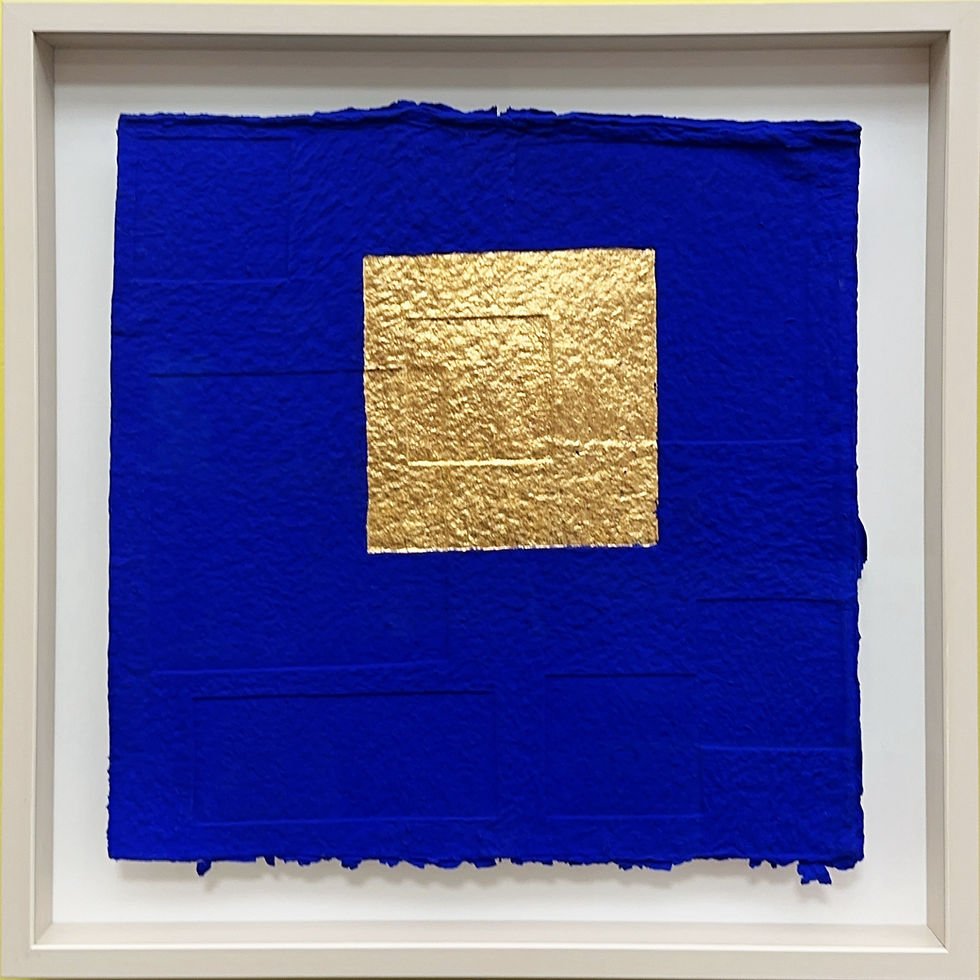
Handcrafted paper, Ultramarine acrylic paint and Gold leaf - 60 x 61 cm in a private collection

Handcrafted paper, Ultramarine acrylic paint and Gold leaf - 60 x 61 cm € 4,500 excl. VATA
Pain is not his subject. Pain is his weather—ever-present, shaping the landscape in which every brushstroke, material choice, and gesture must fight for existence. His practice, therefore, is not grounded in inspiration but in opportunity: the narrow windows of reduced pain when painting becomes physically possible. In these small openings, he works with the urgency of someone who knows the moment will close, and the body will reclaim its limitations.
The result is an oeuvre of extraordinary emotional clarity—works that feel wrested from time rather than produced within it. They carry the unmistakable vibration of a life lived with mortality sitting on the shoulder, whispering reminders of brevity, fragility, and the unbearable beauty of the present moment.
The Body as Studio, The Illness as Metronome
For Otten, the studio is not a neutral space but a battlefield. His longtime struggle with Lyme disease does not merely disrupt productivity; it shapes the entire architecture of his creative worldview. He often describes his practice as occurring in “lower pain periods”—a phrase that quietly indicates how creation, for him, is an act of defiance against a body that has betrayed him.
Working while thinking is painful. Working while moving is painful. Even the cognitive act of choosing colors can be difficult on certain days. And yet, the art continues—sometimes explosively, sometimes slowly, sometimes over years.

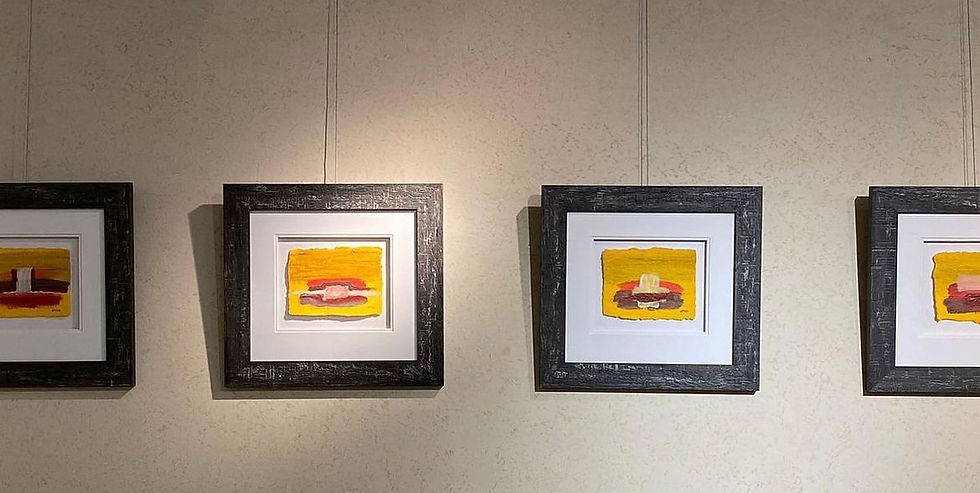
Elastic Blue Composition. Elastic Bandages, the Blood Red Color and the Brown - 30 x.30 cm
€ 300 excl. VAT
Many of his paintings display this dual temporality: an initial violent gesture embedded within layers of patient reconsideration. Some works contain surfaces scraped back repeatedly, revealing histories of emotional weathering. Others show rapid impulses—sharp strokes, torn papers, stains—that seem caught in a moment of desperation or breathlessness.
Art historians often describe such marks as “expressive.” But for Otten, expression is not style; it is circumstance. The brush moves because the body can, at that moment, tolerate moving it. Gestures are not metaphors—they are survival.
This is why his surfaces often appear both forceful and fragile. Behind every mark lies the knowledge that it might be the last mark of the day, or the week, or the month. The works become temporal fossils of a life lived between episodes of pain.

Arie Otten, Apeldoorn, Netherlands
Many of his paintings display this dual temporality: an initial violent gesture embedded within layers of patient reconsideration. Some works contain surfaces scraped back repeatedly, revealing histories of emotional weathering. Others show rapid impulses—sharp strokes, torn papers, stains—that seem caught in a moment of desperation or breathlessness.
Art historians often describe such marks as “expressive.” But for Otten, expression is not style; it is circumstance. The brush moves because the body can, at that moment, tolerate moving it. Gestures are not metaphors—they are survival.
This is why his surfaces often appear both forceful and fragile. Behind every mark lies the knowledge that it might be the last mark of the day, or the week, or the month. The works become temporal fossils of a life lived between episodes of pain.
It is no coincidence that Otten is drawn obsessively to old materials: antique frames, medieval pigments, Rembrandt’s glues, centuries-old papers, discarded construction fragments. These materials mirror his understanding of the body as something worn, eroded, scarred, and yet capable of holding immense depths of history.
His studio looks less like a contemporary workspace and more like an archaeological depot. He travels to other countries to collect antique frames—each bearing another era’s aura of craft, hands, and time. He speaks of these frames as if they contain “stories” that need to be placed around something equally alive.
In many works, the frame is not a neutral boundary but a collaborator. The ornate 18th- or 19th-century frame, with its decorative carvings, becomes a counterpoint to the raw, modern, often brutal surface within. The contrast produces an uncanny tension: the delicate and the violent, the historical and the immediate, the stable and the wounded.
His choice to work with medieval glues or Rembrandt-era binders is not nostalgic. It is a philosophy:
to build art not on new materials that promise permanence, but on ancient ones that have already survived time’s erosion.
When he uses paper from old mills, or scraps found in building sites, or objects from cafeterias and city streets, he is performing an act of emotional archaeology. He resurrects what others discarded, turning debris into a bearer of meaning.
One might say he works with materials the way he works with his own body—accepting the brokenness, honoring the fragility, and coaxing something beautiful from it.

Reused Circles. Handmade paper, fabric and acrylic paint - 44 x 63 cm
€ 450 excl. VAT
The Art of Limited Time
Most artists fight with time; Otten negotiates with it. Because of pain cycles, he cannot plan long uninterrupted days of work. Instead, time becomes chopped, unpredictable, precarious.
In some works—especially mixed-media pieces with torn layers or heavy gestural sections—the sense of urgency is palpable. You feel the speed: the brush pushed quickly across canvas, the pigment scraped, the paper ripped, the charcoal dragged with trembling truthfulness.
But in others—those that take years—the slow patience of healing is visible. Many works contain hundreds of micro-gestures accumulated over years of intermittent labor. These pieces feel like diaries written in layers rather than words.
The duality of his temporality—urgent bursts and prolonged accretion—gives his work a living tension. Each artwork contains, at once: the momentary impulse of survival, and the long arc of ongoing endurance.
This temporal complexity is one of the distinguishing qualities of Otten’s oeuvre.
- Mika (Jaeyun) Noh, Critic, South Korea
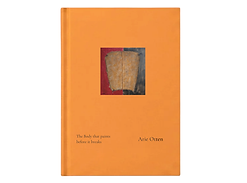
THE BODY THAT PAINTS BEFORE IT BREAKS
€ 54 excl. VAT + shipping
Biography
Arie Otten (b. 1954, Apeldoorn, Netherlands) is a multidisciplinary artist based in Apeldoorn whose practice spans acrylic on canvas, mixed media on paper, sculpture, and installation. His materially incisive approach integrates found industrial elements, textiles, wood, and aluminum with acrylic paste, ash, and blood powder, generating layered topographies that negotiate between material presence and conceptual depth. Informed by the aesthetic legacies of Abstract Expressionism, art informel, and Cobra, Otten constructs a visual language defined by gestural intensity, textural experimentation, and an acute sensitivity to the ontological charge of materials.
At the core of Otten's artistic inquiry lies his sustained engagement with Carl Jung's notion of the "collective unconscious," articulated through totemic archetypes, mythic figuration, and symbolic structures that occupy the threshold between the intuitive and the primordial. His works often dissolve the traditional division between figure and ground, allowing hybridized forms to surface within chromatic fields of luminous resonance. Through collaborative sculptural projects and his use of unconventional materials, Otten cultivates an eco-symbolic framework that reflects his deep affinities with natural forces, flora, and fauna. This synthesis of material experiment and archetypal inquiry positions his oeuvre as a speculative search for a renewed human subject shaped by shared memory, instinct, and ecological interconnectedness.
Arie Otten's work has been exhibited internationally, including The Warrior Empath (curated by Dorron Britz, Vedica Art Studios and Gallery, Paris, 2025), Parasitó (curated by Dorron Britz, in collaboration with the Consulate of Mexico in Mumbai, Vedica Art Studios and Gallery, 2025), La Rupture du Désir (Vedica Art Studios and Gallery, Paris, 2025), the Global Open Studio Visit (Vedica Art Studios and Gallery, 2025), Faces (solo show, Vedica Art Studios and Gallery on Artsy, 2025), and The Power of Blue (curated by Dr. Caterina Corni, Vedica Art Studios and Gallery, Mumbai, 2024). His works have been exhibited at the NOISE Media Art Fair (represented by Vedica Art Studios and Gallery, Vienna, 2024) and Art Miami, 2024 by Jessica Abbey. His practice has been featured in Art on World Magazine, and he received an honorary mention for Patterns of Memory at Vedica Art Studios and Gallery.
CV
Selected Exhibitions
2026 The Weight of what remains, curated by Siddhant Khattri, Susan Fraser-Hughes, Vedica Art Studios and Gallery, Mumbai, India
2026 In Search of Habitable Futures, curated by Siddhant Khattri, Susan Fraser-Hughes and Rajul Shah, Vedica Art Studios and Gallery, Mumbai, India
2025 The Warrior Empath, curated by Dorron Britz, Vedica Art Studios and Gallery, Paris, France
2025 Parasitó, curated by Dorron Britz, Vedica Art Studios and Gallery in collaboration with the Consulate of Mexico in Mumbai, Mumbai, India
2025 La Rupture du Désir, curated by Dorron Britz, Vedica Art Studios and Gallery, Yellow Cube Gallery, Paris, France
2025 Faces, Vedica Art Studios and Gallery, Online Exclusive - Artsy
2024 The Power of Blue, curated by Caterina Corni, Vedica Art Studios and Gallery, Mumbai, India
2023 ArteBo Gallery, Bologna , Italy, Group Exhibition. (ArtOnWorld)


